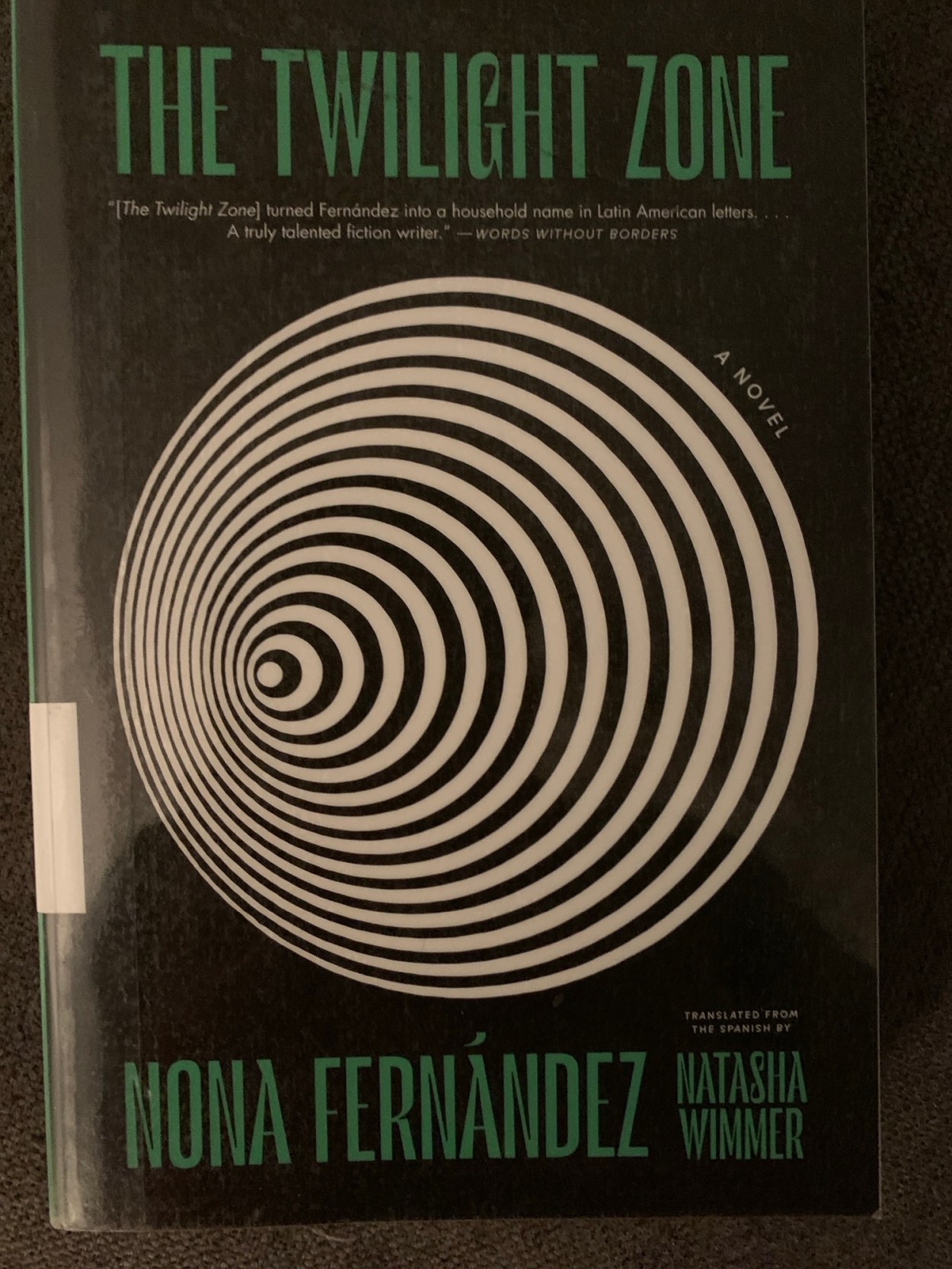
As we enter a strange an unnerving moment in the history of the United States, I found myself being drawn to other histories, shockingly recent histories that might foretell this country’s future. There have been countless analogies to the current Trump administration spearheading an American Reich [login required] — the word fascism has been thrown around like confetti. Personally, I saw it as something less brazen but no less troubling, something akin to the myriad right-wing dictatorships that sprung up across Central and South America during the 20th century. I was familiar with their whereabouts (Nicaragua, El Salvador, Columbia…) and some of their specifics (Argentina’s ‘dirty war’ was not completely alien to me), but I returned time and again to Augusto Pinochet’s regime in Chile. I knew this name and I was vaguely aware of the oppression his rule brought about, but I had not done any formal research on the subject, no dedicated reading. I turned to my local library for resources.
Sadly, there were only a few titles available, but one stood out: a novel, translated from Spanish, written by a Chilean woman who had grown up during Pinochet’s dictatorship. It’s English title was The Twilight Zone (originally published as La dimension desconocida) and I immediately checked it out. Its pages revealed a story simultaneously complex yet also viciously simple. It tells of elaborate plots, sophisticated intelligence gathering operations, spycraft, shifting allegiances and a vast network of censors, police officers, agencies and agents that the regime deployed to stifle dissent and eliminate opposition. This is the better-known story of Chile in the 1970s and 1980s — the violence, the suspicion, the disappearances, the vigils and the waiting for word from a silent government.
But The Twilight Zone ventures far beyond the history. Our narrator (fully aware that her work involves researching, telling and even imagining stories) weaves the story around major and minor characters, some real and verifiable, others invented or, perhaps, composites of many people. At every step we are reminded that the atrocities committed by the Pinochet regime were largely obscured or ignored by many people hoping to avoid trouble or, perhaps, genuinely ignorant of what was happening in their country, their cities and the neighborhoods. There were notable arrests, gunfights, protests and assassinations, but they all seemed to run parallel to the horrors being perpetrated at the military’s secret detention centers by men like Andres Antonio Valenzuela Morales, the man who tortured people.
The narrator repeatedly uses this name in place of his actual name. Even though the man who tortured people ultimately breaks with the regime and gives his testimony to an opposition magazine, he can never shake that identity. It is as if we are meant to remember, whatever good things he might have done, whatever light he shone on the regime’s actions, however much closure he was able to provide to grieving families, he was and remains forever the man who tortured people. His story is, in many ways, the focus of the novel, but he also is like a ghost, appearing at the edge of photographs or for a fleeting moment in a news broadcast. He is everywhere, yet nowhere, a man who had a hand in many of the recorded atrocities but was also just one of many agents and officers who carried out their orders without argument, although not necessarily without conscience. I do not know if there was a Soldier First Class Andres Antonio Valenzuela Morales, that tortured fellow Chileans. I do not know if he sat across from an opposition publication’s editor and recorded his confession on an old-fashioned tape recorder. I do not know if he actually escaped the country and made his way to France to live out his days in exile. I do, however, know that the man who tortures people represents a small beacon of hope in what is often a shadowy and dangerous world.
But what does this have to do with the current political situation in the United States? Donald Trump did not lead a military coup and install himself as supreme leader. He was elected in as fair an election as we can hope for and was handed power by the previous president with all the appearances of a peaceful transition of power. Is it as hyperbolic to liken Trump to Pinochet as it is to compare him to Hitler? Perhaps it is, but we are standing on ledge, possibly closer to falling off than at any time since the American Civil War. As we speak, Elon Musk and his band of DOGE disciples are rampaging through Washington, laying waste to entire departments, metaphorically decapitating thousands of federal employees in what has been called, not without reason, a massive purge under the pretext of saving ‘the American people’ trillions of dollars even though there’s been no clear explanation what (or who) will profit from it. Donald Trump has made no secret that he plans to dismantle regulatory bodies, oversight agencies, enforcement departments and law to create his vision of a new America. At the moment, there is little meaningful opposition from Democrats and there is almost no pushback from within the Republican Party. What we are witnessing is our country’s descent into our own twilight zone. The man who tortured people might, for all we know, already be stationed in some non-descript house or office building awaiting the arrival of his victims. Let us hope he sits down to testify before his pants become stained with blood.
 Antidote Notes